

Storytelling in Job Interviews: The X-Factor That Makes Your Communication Shine – Part 1

Job interviews are usually a headache, but they don’t have to be. In the first of two articles, Tomás explains how storytelling can help you showcase your value in front of the interviewer – based on a careful analysis of both the recruiter and your strengths.
The Strange Case of a Job Interview on a Beach
The most awkward – and successful – job interview I’ve ever had happened about fifteen years ago, while I was lying on the beach. Yes, I’m not kidding. During a break between exams, I was enjoying the sun with a group of college friends when, out of nowhere, I got a call from an unknown number. I picked up, and a woman’s voice said:
— Good morning. Am I speaking to Tomás?
— Yes, it’s me. Who’s calling?
— I’m from the Human Resources department of Company X, and I’d like to conduct a brief interview with you. Do you have ten minutes to answer a few questions?
Honestly, I couldn’t believe what was happening. I knew I had applied for a summer internship at that company, but I wasn’t expecting the call at that moment and I was definitely not prepared to answer anything. Still, I got up, walked to a quieter spot, and did my best to respond.
A couple of weeks later, I received the unexpected news: the internship was mine. What a crazy thing! But also, a small glimpse of hope for all of us.
An Interview is a Conversation
Unlike the experience I’ve just described, going to a job interview often feels like going to the dentist: we’re nervous, anxious, and praying to leave the room as soon as possible. But once we move from the doctor’s office to the business one, we suddenly want to make a good impression and “sell ourselves” in the best possible way.
No matter how many interviews someone has done throughout their career, it’s perfectly normal to feel the tension of the moment. After all, the interviewer is assessing us from the beginning to the end – which becomes even more uncomfortable if there’s more than one person in the room. And the nervousness revealed by our verbal and non-verbal language simply means we care about that occasion, because something important is at stake.

However, I believe we can approach these interactions from a different – and more positive – standpoint.
First, a job interview doesn’t have to feel like a police interrogation. It can be a friendly conversation: an exchange of information where both sides try to understand whether their interests and expectations are aligned for a particular role. In other words, it’s an equal-power dynamic. Both can win; both can lose.
Second, although the interviewer usually leads the conversation, the candidate can – and should – ask questions about the company’s culture, working conditions, career development, and more. On the one hand, this helps confirm whether the candidate truly wants to join the firm; on the other, it signals curiosity, proactivity, and preparation – extra points in the eyes of the recruiter.
Lastly, a conversation evokes a more fluid and stimulating communication, as well as a relaxed environment, opening the door to “human elements” such as humor, empathy-building, and storytelling.
Storytelling: Your X-Factor
By the way, have you ever told a story during a job interview? Not just listing facts or credentials, but sharing an actual story – with characters, emotions and visuals – that reveals who you are and engage your audience?
As one of my students sharply put it:
“Storytelling will help me shape and express my personal brand by turning my experiences into meaningful narratives. It allows me to show how I think, adapt, and solve problems, rather than just listing skills.”
Dear candidate, whether you’ve done it before but see room for improvement, or you’ve never tried it but believe in its potential, this is the moment to enhance your communication with extra doses of passion and intention.
In these next two articles, let’s raise the bar. Let’s humanize your speech not to entertain, but to reinforce the value of your personal brand. Remember: you’re competing with dozens or even hundreds of candidates, so you must stand out with authenticity and strategic thinking. And this is where storytelling in job interviews becomes your competitive advantage: when you tell a story, you capture attention; create connection, and highlight your strengths in a unique and memorable way.
In other words, you transform an ice-cold CV into a vivid, personal narrative with a powerful message: “I’m the right one for this job. Hire me.”
Given this background, in this first of two articles, I’m going to cover the first two steps of a five-step methodology to help you apply storytelling in future job interviews.
1. Find Your Audience
Imagine you’ve invited a group of friends over for dinner. The day before, one of them asks if he can bring his new girlfriend. You happily agree and start preparing the meal: a delicious rosemary-and-lemon roasted chicken with potatoes and vegetables. It seems like a great dish, right?
Well… until your friend and his companion sit down at the table:
— Sorry, I forgot to tell you: Isabel is vegetarian. She can’t eat this.
— What? This recipe took me so long to prepare, and it’s so tasty… Why didn’t you tell me earlier?
After the initial frustration, you calm down and reach an uncomfortable conclusion: “Instead of blaming my friend, why didn’t I ask whether his girlfriend had any allergies, intolerances, or food restrictions? Damn… I’m the host – so in the end, it’s my fault.”
This bittersweet moment reveals a simple truth: he didn’t pay enough attention to his audience’s needs. He focused more on the meal than on the people he was about to serve.
Rule of thumb: Before using storytelling in a job interview, you must understand who your audience is. The same logic applies when selling a product or service: we need to know our target before presenting our value proposition.

In this case, before telling your story in a job interview, it’s essential to understand who is likely to interview you – a HR professional, a department manager, or, in case of a start-up, the founder. You can start by checking their LinkedIn profile or other public information. The goal is to incorporate what you learn into your story, so it feels more tailored and connected to the human being sitting in front of you.
On a more strategic level, you must also analyse two additional aspects:
1. The company’s business sector – addressing a bank is completely different from addressing a creative agency, both in words and in attire.
2. The job offer itself – especially the required skills and competencies. That list reveals the “matching areas” between your profile and what the recruiter is seeking.
Take this example:
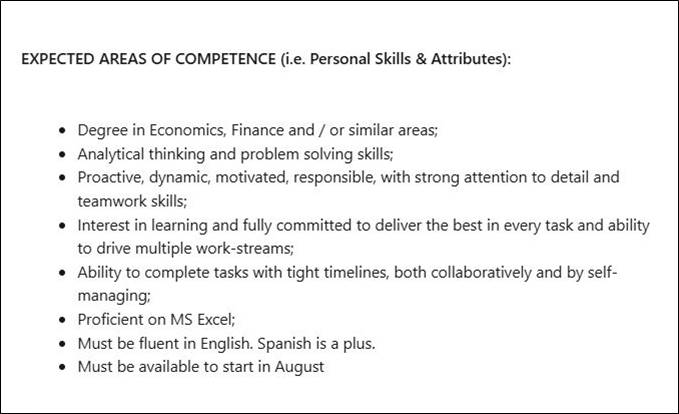
From this list, it becomes clear which “selling points” the company wants to hear, and therefore, which ones you should emphasize. From problem-solving to attention to detail and teamwork, it’s up to you to decide which strengths are most valuable and most authentically yours.
Finally, here are some guiding questions to help you prepare for any job interview, focusing on both practical and inspirational dimensions:
- Who are they?
- What are their needs, struggles, interests, and motivations?
- What environment do they work in?
- Which factors influence their decision-making process?
- How can they be inspired?
- What story do they want to hear?
- How can your story lead them toward a desired action?
Overall, the "find your audience" principle teaches us to be storylisteners first, and storytellers second.2. Find Your Superpowers
Powers of The Fantastic Four
- Reed Richards (Mr. Fantastic): Elasticity, malleability, and high-level intellect
- Sue Storm (Invisible Woman): Invisibility and psionic force fields
- Johnny Storm (Human Torch): Pyrokinesis, flaming body, and flight
- Ben Grimm (The Thing): Superhuman strength and immense durability
If you portrait yourself as a superhero – like one of these Marvel’s characters – you’ll quickly realize that you, too, are equipped with a set of gifts and talents (your superpowers) that, when properly developed, can make a meaningful impact on people’s lives.

Your superpowers should therefore be consciously and strategically woven into your personal story. They help you communicate the right positioning of your personal brand, aligned with both your strengths and, as we’ve seen before, your audience’s needs.
My recommendation is simple: identify three superpowers (values, skills, or competencies) that you want to highlight in a job interview; especially the ones that differentiate you and add the most value to the role you’re pursuing. For example:
- Leadership · Resilience · Adaptability
- Empathy · Communication · Creativity
- Teamwork · Active listening · Problem-solving skills
To support this groundwork, here is a set of guiding questions to help you identify your superpowers, deepen your self-awareness, and clarify the value of your personal brand:
- What characteristics make me a unique and special individual?
- Which values define my character?
- What are my strongest skills?
- Is there a particular talent that I can further develop?
- What do my friends and family appreciate most about me?
- What kind of positive impact do I want to have in the world?
- What is my value proposition?
In short, the superpowers you choose will become the ingredients of the story you craft.Final Remarks
Dear candidate, as we’ve seen so far, mastering storytelling for job interviews is a fascinating process that requires preparation, strategic thinking, and self-awareness. Here are the main takeaways from this first article:
1. A job interview is a conversation.
Conveying passion and enthusiasm is not only advisable; it’s essential to make a strong first impression and create an emotional connection with your audience.
2. Stories matter.
They shape your character, reveal your identity, and make your personal brand unforgettable. That’s why you should invest in this communication tool as much as you can.
3. Before telling a story, do your homework.
First, find your audience. Then, find your superpowers. Only by aligning both can your selling points be perceived as genuine added value by the recruiting company.
In Part 2 of this short series, we’ll learn the remaining three steps to help you excel at storytelling in future job interviews – including how to choose the right story for the right moment. Stay tuned!
And if you need professional support to prepare for an upcoming job interview, I invite you to explore my mentoring and communication training services. From a single focused session to a fully customized training, you’ll find the right tools to showcase your value and land your dream job.



Comentários recentes