

Storytelling in Job Interviews: The X-Factor That Makes Your Communication Shine – Part 2

Storytelling transforms a candidate into a compelling hero. In the second of two articles, Tomás illustrates how personal stories can be collected, organized and how they can be smoothly integrated in a job interview, giving credibility and authenticity to the candidate’s personal brand.
Dear candidate, in Part 1 of this series we’ve covered the first two steps to help you succeed at storytelling in job interviews: 1. Find Your Audience and 2. Find Your Superpowers. Today I invite you to explore the three remaining steps that will help your communication stand out when it matters most.
3. Find Your Stories
Summer 2015: an atypical period between my 1st year Master’s classes and the move to Canada for my exchange semester. Nothing exciting happened: no events in Lisbon, my friends were away, and I couldn’t afford to travel. It was ‘home-gym, gym-home’ on the loop. Quite boring, I have to say. One afternoon in my living room, while doing a quick search on the web, one book suddenly drew my attention: Brand New You: Reinventing Work, Life & Self Through the Power of Personal Branding, by Simon Middleton (2012). I decided to order it. At least, I was doing something useful: investing on myself. The truth is that this book performed a “little miracle” in my life: not only made me realize the importance of personal branding, but also drove me to do all the suggested exercises in a row – something truly remarkable! One of them consisted of listing as many life examples of me being Authentic, Inauthentic, Distinctive, and Excellent. Another exercise invited the reader to make a linear description of their Brand Story, i.e., documenting major life events that shaped the person one had become up to that time. I remember writing about a wide array of experiences like familiar issues, hobbies, talents, classes, exams’ grades, as well as fears, passions, motivations and critical decisions I had to make.

The reason I’m sharing this episode with you is because it unfolds a process you must engage in to be able to tell meaningful stories: google your life; rewind your story and find critical events that resonate with the person you’re today.
Well, now you might be wondering: “why is this relevant in the context of a job interview?”.
3 Reasons:
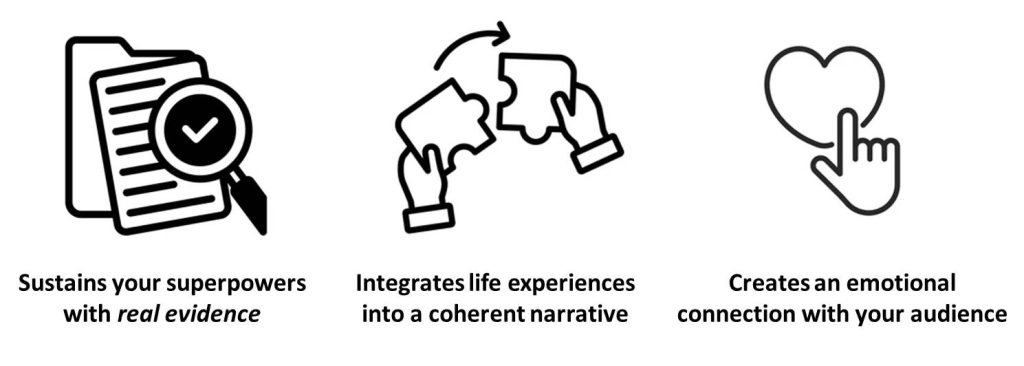
In short: it’s the difference between saying “I’m good at this” vs. “let me show you why I’m good at this”. If we put ourselves in a job recruiter’s shoes, we know which one we’d prefer to hear, right?
Having said that, it’s time to roll up our sleeves and rediscover your life journey like you’ve never done before. To make the task easier, there are two pathways to collect this unique material:
i. Exploratory approach
Through this approach you go with the flow: there’s no particular goal when searching for events, but simply let your mind operate loosely, without constraints. For some people this may seem a bit chaotic and unstructured; for others it prompts reflection and creativity. Regardless of one’s perspective, this is unquestionably a deep dive into the ocean of your inner world, which can generate surprising results. At the end of the day, the purpose is to collect a rich set of pieces of your biography, so that you can make a cohesive and solid puzzle when crafting your personal narrative.
If you’re interested in testing this exploratory approach, please check my article ‘3 Tips to Find Personal Stories and Elevate Your Communication’. In there, you’ll find three basic and intuitive categories to initiate this introspective method.

ii. Goal-oriented approach
As the title suggests, your reflection is no longer unfiltered, but influenced by pre-determined criteria from the very beginning. In other words, you have a clear message in mind when searching for a story. If you recall the 2nd step of our methodology – Find Your Superpowers – this is the strategic information you’ll be using as a baseline to this approach. First you take the three superpowers you selected; then you try to identify concrete examples that reinforce their value.
Let’s look at a practical example of how this works:
Superpower #1: Fast decision-making under pressure
I have often found myself in situations where quick decision-making is essential. I began developing this skill at fifteen when I trained as a camp counselor and first-aid responder for summer jobs. This training taught me to process information rapidly, analyze risks, and make high-stakes decisions for the best possible outcome. Managing large groups of children in outdoor environments is highly challenging; you must notice potential dangers at a glance and know exactly how to react to injuries or emergencies. You have to process information and act simultaneously to ensure everyone is safe. This is a skill you train for, and real-world experience only strengthens it over time.
Superpower #2: Fast learning
I can acquire new skills and knowledge quickly and efficiently. When I was young, my parents enrolled me in various creative disciplines, including gymnastics and music. From an early age, I had to memorize complex routines and musical scores. Because I was often younger than my peers, I felt a strong drive to prove myself. I learned to identify patterns quickly, which allowed me to master new material under tight deadlines. I later transferred this ability to my academic and professional life. For instance, when my team at a previous company was trained on a complex new project management tool, only the first few to master it would lead the account. Thanks to my ability to learn fast, I was selected as one of the project leads.
Superpower #3: Resilience
I view challenges as opportunities to grow, focusing entirely on the factors I can control. During my university studies, my team participated in a business simulation competition where we had to manage a company’s budget and market strategy. Every decision directly impacted our performance, requiring us to analyze market reports carefully. Although we made mistakes and fell behind in the middle rounds, we used those setbacks to cut costs and improve our forecasting. I am used to being pushed out of my comfort zone – whether through moving abroad alone as a teenager, competing in high-level sports, or handling high-stakes university presentations. I thrive in these environments because I know how to turn pressure into progress.
Alternatively, if you’re not drawn into writing, you can draw three columns (each one for a superpower) and list as many examples you can think of in bullet points. This way, you create a life database filled with rich content, and without putting too much effort.
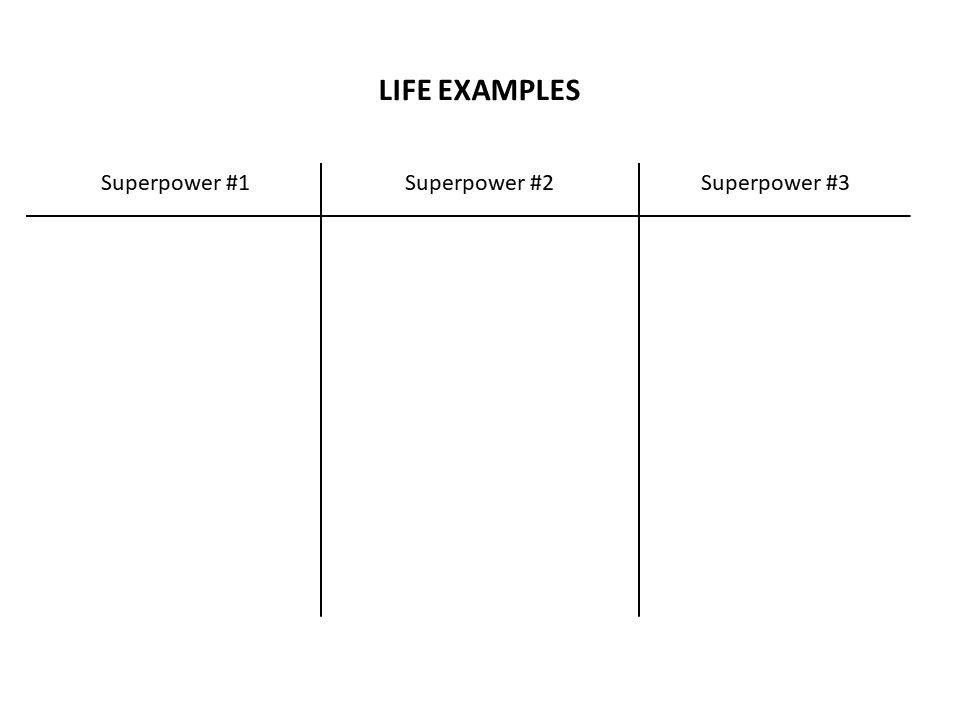
Remember: you’re digging “gold material” – unique, rare, valuable, and of the highest quality – to showcase your value in job interviews.4. Find the Right Stories to Tell
Now that you’ve gathered rich material, it’s time to be pragmatic and strategic in the choices you make in the light of the 1st principle: Find Your Audience. The challenge is the following: matching your life experiences with the recruiter’s profile and the specific demands of the role, so that you position yourself as the right candidate for the job. And there’s no better way to do this than recall some of the questions suggested in the first article:
- Which factors influence their decision-making process?
- How can they be inspired?
- What story do they want to hear?
- How can your story lead them toward a desired action?
Answering these questions, you should be able to select a minimum of 3 stories – one per superpower – that set you apart as the “compelling hero” the company is searching for.
Keep this in mind: it’s not about what you say, but how you make them feel. So make sure you activate their imagination with powerful and authentic storytelling.5. Find the Right Moment to Tell

The 5th and last step of our Methodology concerns the moment of truth: applying storytelling on stage – when you have the interviewer(s) in front of you. In this regard, you must be aware of the sort of questions they usually ask (which I believe many of us do), so that you can respond with precision and intention. But the real trigger here demands us to move one step further: which questions allow you, or encourage you, to tell a story?
Please find below a list of questions that prompt you to apply storytelling in job interviews:
- Tell me a bit about yourself…
- Why do you want to work for this company?
- What are your three greatest strengths?
- How do you handle pressure or tight deadlines?
- Describe a situation where you showcased your leadership skills.
- Tell me about a time you faced a difficult challenge at work.
- Tell me about a time you made a mistake and how you handled it.
Among these, three questions deserve special attention.
1. Tell me a bit about yourself…

Vague. Broad. Tricky.
The goal is to get to know you.
Get the impact of your first impression.
Accordingly, you must provide a cohesive overview about your life story that help the interviewer understand who you are. Therefore, it’s advisable to structure your narrative in well-defined blocks, which usually take the shape of a standard timeline:
- 1. Academic background, 2. Professional experience, 3. Superpowers
Nevertheless, you can opt by a more disruptive approach:
- 1. Personality, 2. Motivations & Experiences, 3. Superpowers
- 1. Field of Study_1 w/ Experiences & Superpowers, 2) Field of Study_2 w/ Experiences & Superpowers, 3. Field of Study_3 w/ Experiences & Superpowers
Rule of thumb: since we’re in the beginning of the conversation, don’t say it all; reveal just enough to spark curiosity and invite deeper conversation.2. What are your three greatest strengths?

Clear. Direct. Assertive.
Give them the answer right away: your three superpowers. Right after, you can say something like: “If you give permission, I can provide you a couple of examples that justify this choice.” If the interviewer agrees, you have carte blanche to tell the story you carefully prepared.
See? All of a sudden you changed the rules of the game; you’re in the driver’s seat, taking the interviewer down the route you want.
Rule of thumb: play the game: drive the interviewer to your greatest asset – your storytelling.3. How do you handle pressure or tight deadlines?

Open, but direct.
Subtle, but intentional.
Spotlight on a specific skill.
Answer the question straightforwardly, followed by a story that illustrates your capacity to handle pressure or tight deadlines. Example: the time you delivered a financial report to your boss in less than a week; the time you managed a customer complaint in record time with a positive outcome.
Rule of thumb: the more you prepare, the more natural these questions will feel. And that translates into confidence, charisma and memorable presence.Recap of the 5-step Methodology
Dear candidate, in this short series we’ve covered the five basic principles for you to apply storytelling in job interviews. Here’s a quick review of each one of them:
1. Find Your Audience
Before you speak, understand who’s listening. Every recruiter has expectations, motivations, and decision-making criteria. When you know what they value, you can shape your message in a way that resonates with clarity and intention.
2. Find Your Superpowers
Your strengths are the anchors of your personal brand. Identify the three qualities that truly define you – the ones that show up consistently in your life – and let them guide the narrative you bring into the room.
3. Find Your Stories
Your experiences are the emotional proof behind your strengths. Revisit your journey, collect meaningful moments, and rediscover the episodes that reveal who you are. These stories give depth, credibility, and humanity to your communication.
4. Find the Right Stories to Tell
Not every story fits every interview. Choose the ones that align with the recruiter’s needs and the role’s demands. Relevance is what transforms a personal memory into a strategic message that positions you as the right candidate.
5. Find the Right Moment to Tell
Interviews are full of openings: questions that invite reflection, examples, and personal insight. Recognize those moments and use them wisely. When you share the right story at the right time, you create connection, confidence, and impact.First, find your audience. Then, find your superpowers. Only by aligning both can your selling points be perceived as genuine added value by the recruiting company.
Final Remarks
If you need help crafting a particular narrative and delivering it in live action, I advise you to read three complementary articles of my blog which shed light on these topics:
1. 5 Magic Techniques to Spice Up Your Stories✨
2. The Power of Silence in Storytelling
3. The Geometry of Gestures in Storytelling
However, if you prefer receiving professional support to prepare for an upcoming job interview, I invite you to explore my mentoring and communication training services. From a single focused session to a fully customized training, you’ll find the right tools to showcase your value and get the job you want.
Good luck and see you soon!



Comentários recentes